SPRING / SUMMER 2026 TRENDS
THE RAW RAISON D’ÊTRE
Each year brings a fresh cycle of top-level political absurdity. Expecting creativity to thrive in the constant churn of efficiency, geopolitical tension, and our beloved ‘economic uncertainty’ is unreasonable, especially as AI rewrites the script in real time. Rome wasn’t built in a day—but fuck, AI probably could have done it, em dash and all.
Consumer sentiment isn’t melodramatic for adopting a doomsday stance. That’s life. It continues anyway. So we keep reframing what we’re living for each season and where we imagine society is going. How do we detach from a seductive level of ease? Lately, our innovation pipeline, in macroeconomic terms, has been our humanity itself.
Our priorities are shifting. Film and nostalgia are rising. Communities are romanticizing gatherings to play chess or run together. We’re even romanticizing the person who avoids Instagram. Elusiveness has become a form of currency.
At the same time, we’ve built an animalistic, fragmented digital ecosystem where every engagement online becomes a clash of values. Rage-bait keeps the wheels spinning for brands. At what point does human exchange degrade enough that we stop trying to align our morality in favor of a feedback loop of digital validation? Why would the average consumer want to publicly engage or identify with anything anymore? All they do is get yelled at by competing algorithm cults.
More people are asking what it means to live in the present and live well. We crave a rawness that AI therapy can’t simulate. We need tactility or we lose our minds. Think about solitary confinement. Would it be any less solitary if you were handed Instagram and TikTok?
After the pandemic, we overcorrected the knowledge economy. We know too much, too often, everywhere, and we’re creating so many conversations that the idea of a single “right thing” becomes impossible. There is no universal correct thing. Take microtrends. In the last five years, we built a culture of miniature perfectionisms that compressed identity into rigid rules of what to do and what not to do. Thankfully we woke up from that fever dream. How long could we have existed in a categorical world of bloke boys and cottage girls? Would we have had to make children choose a category at birth?
Enter the urbanite of SS26, the first physical embodiment of a cultural step back toward raw rigidity and deflated ego. We’re moving into an era where you don’t need to define yourself on paper to prove anything to anyone—to prove you’re someone. The SS26 woman is attuned to her physical environment because she actively lives in it. Her new raison d’être is to mirror her surroundings with raw functionality, refined minimalism, wearability, and smart outdoor pieces. She chooses a lifestyle that helps her get things done with her own hands because she cannot afford to be anything but fluid. She is also exhausted by the internet dictating her choices. She will figure it out herself, as humans have done for thousands of years, learning within the natural margin of error.
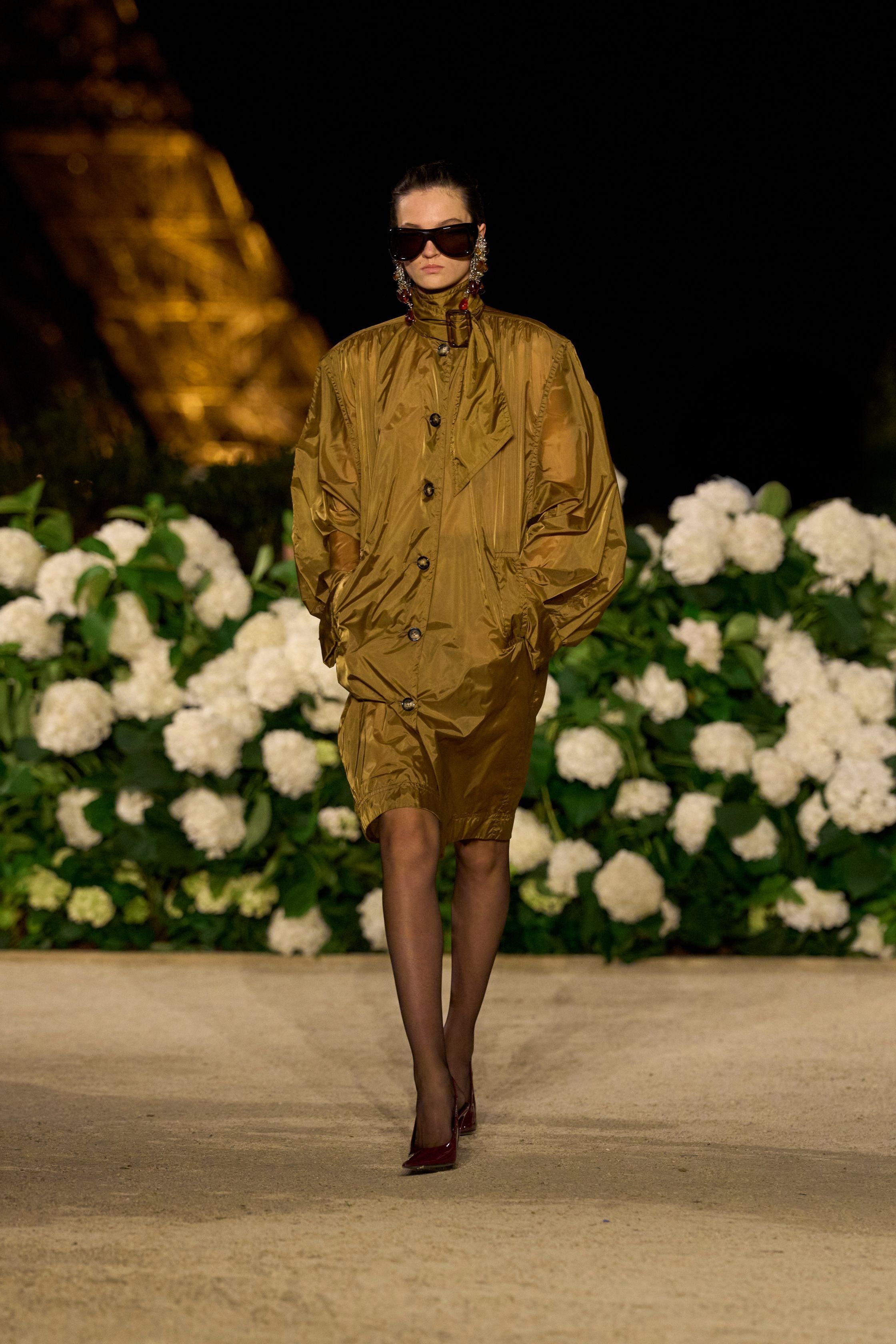
In SS26, we see a blend of classic office attire and athletic pragmatism. There are Saint Laurent raincoats built for the city, Coperni thong sandals for quick exits, and brut, durable denim from Ahluwalia. We invest now because we need things that last. Everything is multipurpose, singular in code, and naturalistic. Kent & Curwen illustrated this flawlessly with a palette that mirrors the environment: Pea Green, Pickled Green, Dusty Green layered together. There is Vanilla Yellow and Popcorn Yellow, with a wider rise on the horizon, as seen at Jacquemus. And it is almost guaranteed that Rhode Beauty’s marketing team will soon push creamy yellows. Their strategy is color data. The script writes itself. Men’s SS26 echoed the same naturalistic sentiment, a seismic return to the naturesque as a visual ideal and a genderless foundation.
The emphasis is on ease and neutrality. It isn’t minimalism because nothing about this is minimal. It works hard for adversity and functionality by creating wardrobe circularity that still feels tactile due to its stiffness and untreated textures. And you layer. Then you layer again. You don’t reinvent. You mix fitted and baggy silhouettes, and like Alaïa, you account for what the physical landscape actually is: curvy, strict, loose, evolving. It is Prada’s windbreaker shells, overalls, funnel necks. All made from fabrics that withstand unpredictable weather: shell, cotton twill, rainproof textiles. This connects directly to the trend of romanticizing styling over possession. The person who knows how to style is a survivalist. They refuse the easy way out—an anti-nod to AI and hyper-efficiency.
Footwear follows the same narrative. Boat shoes return as slides. Moccasins hybridize themselves to adapt to aesthetics instead of clinging to labels. Nothing is sharp or angular. Everything is soft and rounded, aligned with our desire for flexibility and the deconstruction of geometries that define social codes. It is, quite literally, taking the shape of the outside world and merging sportiness with sophistication. A symbiosis between body and landscape.
The lure of digital conformity has created a hunger for unplugging, escaping, and seeking affordable lifestyles. The SS26 woman pioneers a cultural shift toward the “touch grass” aesthetic. We now prioritize utilitarian uniformity that exudes self-confidence. It must be honest to the world we live in, durable, long-lasting. Even for the most discerning aesthetes.
CREATIVE DIRECTOR’S CUT
For the first time in a fashion cycle, and given the immediate global reach of social media today, a social shift did not paint itself through a visual narrative but became the narrative itself: the long-awaited debuts of the CD musical-chairs cycle.
“Do you Dare Enter the House of Dior?” opened Jonathan Anderson’s collection, a name now deeply tied not only to fashion, with over ten collections per year, but also to film vernacular. Does he sleep? Obviously not. The attitude behind it—“you know what, fuck it, let’s see it”—could have been the title card for every house this year, as new faces stepped into Chanel (Blazy), Bottega Veneta (Trotter), Balenciaga (Piccioli), Gucci (Demna), and more. Who won the musical chairs?
But does the idea of a “winner” measure the success of the brand or the person? Can the two be separated? Or is it too ambitious to think that hard when fashion’s social audience is large enough to have watch parties at Parisian cafés? The same audience that’s at each other’s throats on social media over global politics comes together in solidarity when it comes to being seen in the elusive “it person” room of the day. Maslow at work, I suppose.
What the new CDs did well was pay proper homage to the legacy roles they were stepping into, which was the safe bet for a first cycle under a new house name. Pay your dues; see you in FW26. Piccioli nodded to Cristóbal’s heritage and to the modern volume Demna brought to Balenciaga’s silhouette. Burberry went to Glastonbury, as the British instinctively do. Loewe retained its “Spanishness” under McCollough and Hernandez. Gucci reminded us it remains a wealthy household name through Demna’s “The Tiger.” Blazy carried the burden of tweed and made the Chanel girl more wearable, more commercial.
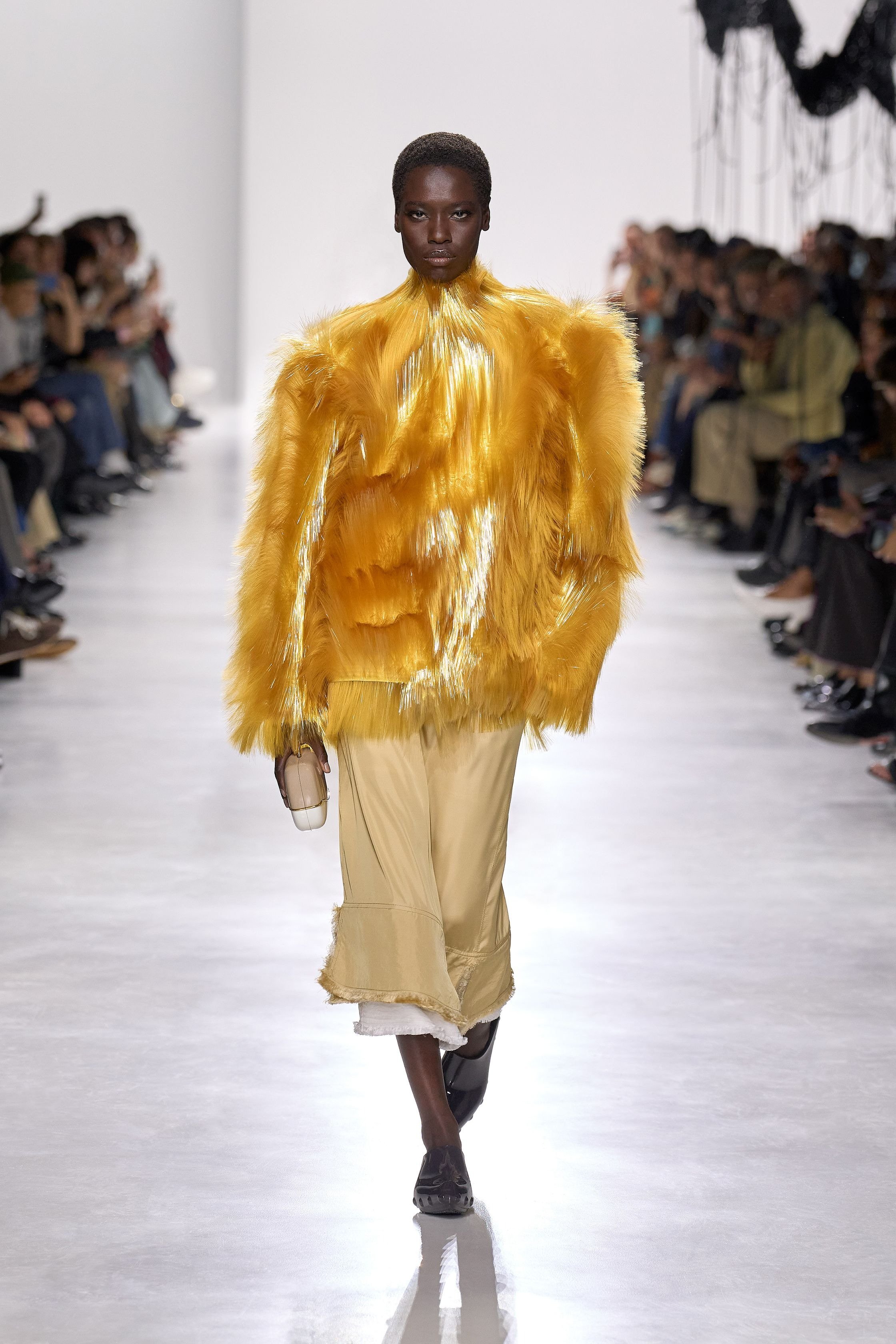
A new line of leadership has settled, and Louise Trotter delivered the boldest nouveau-guard statement, ushering a fresh start at Bottega with a season-grabbing fiberglass look that demanded her belonging. Fashion has long craved a sophisticated, fresh-faced, feminine touch in a tired cycle of CD legacy pass-arounds. Seeing a newer face break through is refreshing.
Centering a season on the human touch behind legacy brands that will inevitably exist is an innovative way to cement a house’s identity while demonstrating the economic return of a “debut” of a house’s “brand.” It is fashion’s new trompe-l’œil: designed to engage you—and yes, to make you buy. The macro snapshot is clear: by reshuffling creative directors, capital-F fashion sustains a decade-long trend. Big companies grow bigger; the small can barely compete. Pikettyesque. The only counterpoint came from Laura Weir in London, through her newly implemented BFC Fashion Trust for SMEs—an attempt not to equalize the competitive landscape but simply to allow small enterprises to exist. This feels natural in London, the hotbed of new designers and the only city on the fashion calendar where you can still start from nothing and build something consistent.
Outside of that, we are too shielded, even enamored, with the cycle of CD placements that we should not romanticize. We’re illustriously keeping power in the hands of the same people. Endlessly. How can history be made, and new ideas emerge, when we keep rebranding the same twenty people? And why is this not part of a broader conversation about competitive equity? Food for thought, cake for thought… let them eat it.
SECOND COMING OF MENTUS COPUS
For fashion, for marketers, for anyone offering a commodified good, it is crucial to understand that the global audience has been quietly rewriting traditional standards over the last decade. Retirement schedules, family planning, life stages, the very definition of youth—these markers have shifted, revealing the contemporary “middle life” milestone and the necessity of stretching it, attending to it as if it were the most urgent work of one’s life.
We’re living for today because imagining, let alone affording, the future feels impossible. As bleak as that may seem, it is also an opportune moment to embrace reinvigoration and nowness. The reality is that now is all we have; we cannot rely on the security of tomorrow—its climate, economy, our financial stability, our health, even our homes. It is the second wave of hedonism since COVID-19: an appetite for instant dopamine, doing things now, and doing them big.
Where enjoyment abounds, flexibility follows. 45% of US consumers in 2025 say they like to stand out from the crowd, up from 36% in 2023. In a world where logging onto your phone triggers waves of “try this,” “listen to this,” “watch this” culture, the abundance of choice—the paradox of choice—is overstimulating. No single person can master all of it, and the corruption of recommendation culture has created algorithms that favor consumer craving over beauty, leaving our aesthetic sensibilities numbed.
We see people logging off. Elusiveness is the new cool. WGSN calls this emerging group of extroverts “The Gleamers”—post quiet-luxury urbanites seeking to scale daily joy. Much like the Dopamine Dressers we witnessed immediately after global lockdowns, they are hedonists breaking out of digital routine, signaling that consumers crave novelty and absurdity in late-stage postmodernism. Consider our newfound idolization of millennial cringe: people being cringe is now freedom itself. We also romanticize the entirety of 2016, which, stripped of its flounce, was simply everyone posting without inhibition. It was unrestrained interconnectivity we have been taught to censor in the last five years.
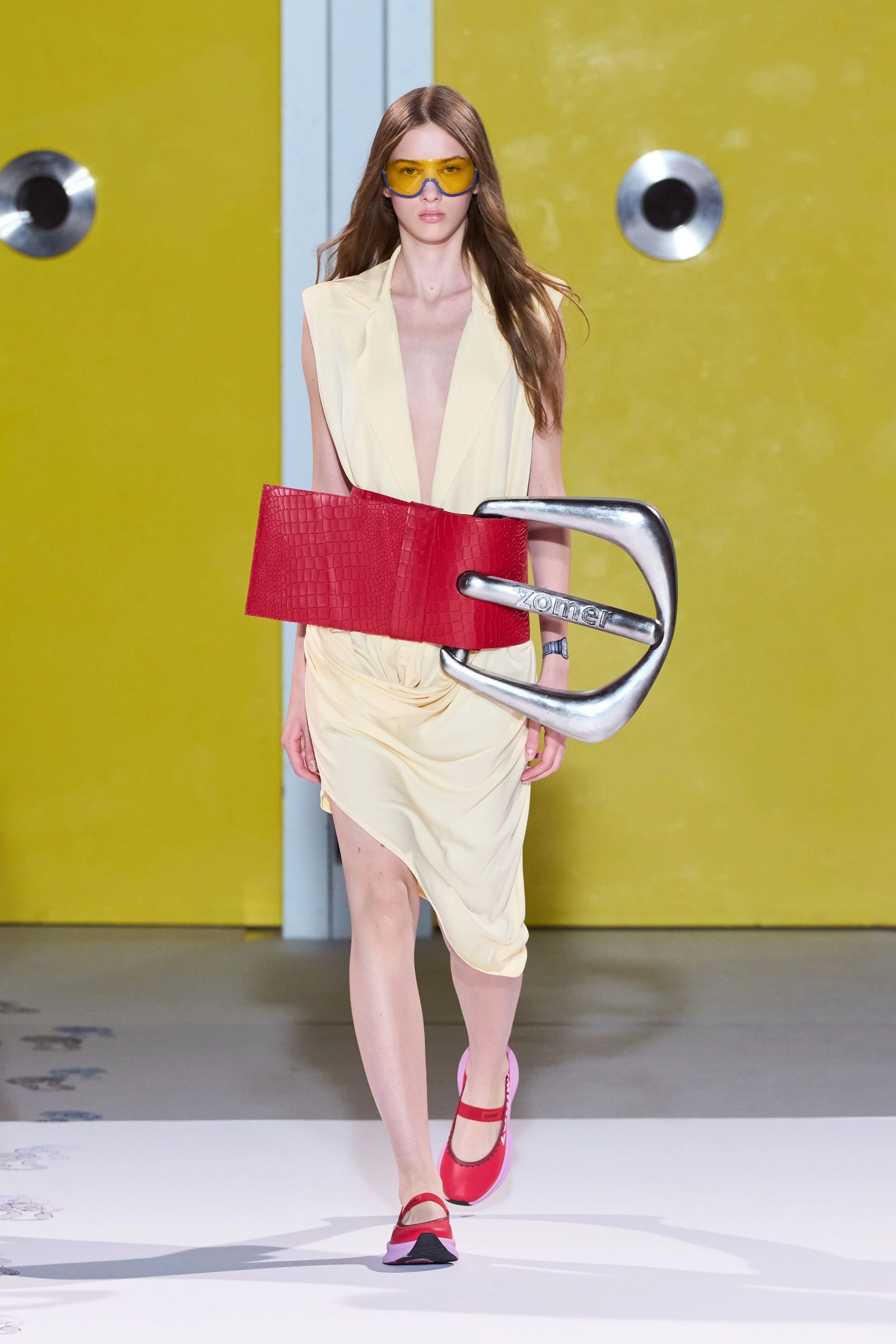
SS26 amplifies this desire for daily joy in a harlequin way: polka dots, paradoxes, and messy human moments. It is the capriciousness of Zomer and the zaniness of Diesel eggs in Milan. Polka dots, in particular, feel intrinsically SS26—they could stand alone as a thematic trend. From Altuzarra, Khaite, and Nina Ricci to Junya Watanabe, MM6, and Jean Paul Gaultier, Heuritech has dubbed them the “Big Dots,” with visibility up 55% in Europe in the last year.
SS26 explores irony in relativism and the pursuit of pleasure as reckless as a fast car down a dead-end road. Experimentation in volume appears at Bottega Veneta, vibrant pop-art colors at Connor Ives, quirky layering at Carzanza, and historical references reinterpreted not only for house coding but also in a juxtaposition of old and new, childish and adult, serious and absurd. In this second wave of pleasure-seeking, the SS26 consumer is not returning to post-COVID maximalism but moving toward frivolous decorative dressing simply because why not. It is joyful excess. Paisley, fringe, pop, animal prints, and feathers abound.
When modern society attempts to erase the innate messiness of humans through AI-driven perfection and efficiency, whether in the food we eat, the clothes we buy, or the way we interact (or fail to), a countercurrent emerges that celebrates personhood. SS26 embraces unpredictability, loudness, and imperfection, and within that space, transformation occurs. Faced with your own morality, don’t you also just want to not give a fuck?
SOFIA COPPOLA ARCHIVE BOOK ON HER COFFEE TABLE
As I discussed in my Milan recap, one of my favorite narratives on the SS26 runway was a conversation about female autonomy, fetishization, and a male gaze contradicted by inherent innocence. It felt very Varda, even Rohmer. Within this space exists the dialogue between fragility and rebellion, and how fashion can act as a provocative medium to understand, communicate, and ultimately teach the arcane discord of girlhood.
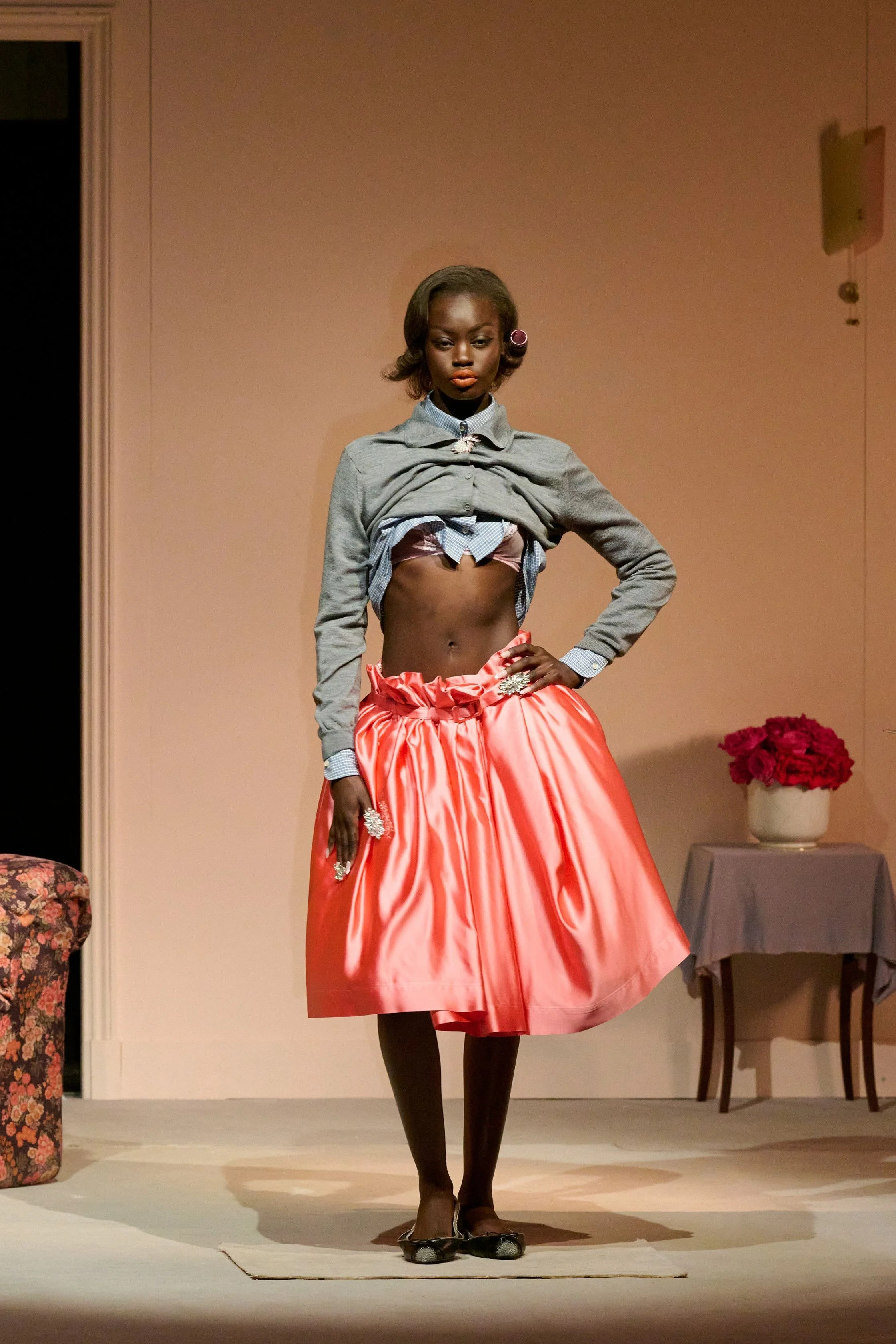
In SS26, there are two dominant modes of thought: the girlish, naive awkwardness of teenage spirit, unburdened by the pressures of labels and societal structures, and her foil, the Porcelain Punk—a maturation of the Coquette female into a rougher, grittier punk-rock persona, drenched in dark berry tones. Between them exist symbols and metanarratives: the apron, the bow, the corset, the stocking, the bra, and so on.
The trend cycle of soft elegance—ruffles, gingham, bows—as a statement of strength had to evolve. SS26 required it. What emerged, in my opinion, is one of the most thought-provoking sentiments I have seen in the last five seasons: a head-on collision between the “undone, imperfect human” seen at Loewe and Prada for two cycles and the messy, coquette feminine girl, seen at designers like August Barron. At this intersection lies one of the most relatable forms of vulnerability fashion can illustrate: awkward girlhood, teenage innocence. It is an angle that cannot be sexualized either as public-private concept (lingerie dressing) or as melancholy from the dark romantic mystique.
Conversely, on runways like Chloé, we see tiered, ruffle skirts returning from previous summers, inching closer to their bohemian realization in next year’s SS27 season. Lace dominates trim, stockings, and even underwear. We see confined female culture: the corsetry and tulle at Rocha, bonnets at Calvin Klein, outward bras at Prada. The juxtaposition of these two approaches creates a space where everything feels airy and innocent, each look playful and steeped in historical reference, a la Marie Antoinette. Dramatic asymmetries and overlays, in butter yellows, lavenders, and baby blues, contrast a lazy notion of playful sensuality, transforming it into a form of strategic transparency. Autonomy, precisely. Is there not freedom in the liberation of clothes and the inhibition of adulthood?
At Prada, we witnessed a sort of sartorial improvisation: we woke up and dressed with whatever was on the floor, because our real concerns were not outward appearance. Further, the apron at Miu Miu acts as modern Dada. Miuccia makes a statement to spotlight women like Fratini, pioneers of equality; muses of womanhood whose invisibility is valorized both internally by women and externally on the SS26 runway: “Work as an expression of effort. Work as a symbol of care and love. Work as a reflection of independence,” as Miuccia puts it. Concurrently, aligned with the guileless edge of SS26 girlhood, our cultural climate views utilitarian objects through a lens of usefulness rather than decoration.
In essence, the SS26 woman is a bootleg Sofia Coppola film: young, wistful, atmospheric, ethereal, but intrinsically female-owned and female-operated. Like a single, ruffled, elegant garment, she contains multitudes. We found critique through pastiche.